
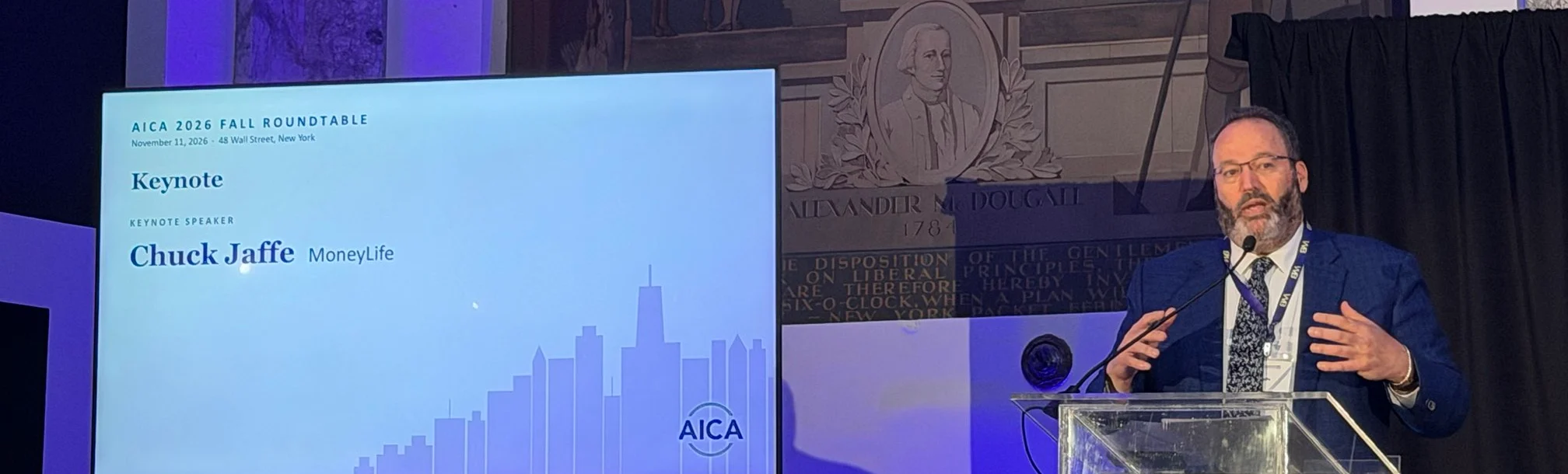
John really undersold the effort he put into getting me here to do this today. I have been the host of The NAVigator podcast for seven years, and I have been coming to these events since they started, usually run‐ning a panel discussion like the one Imoderated earlier today.
And over the years, John and I have be‐come close friends. His father, George Cole Scott, was the definitive source on all things closed-end fund when I started covering the fund industry decades ago, and I knew John before we started doing the NAVigator, but since we started working together, we have become friends. I mean, John was at my wedding celebration a few years ago, his wife Katty now has and makes my mother’s famous cheesecake recipe, we frequently lose an hour chatting around recording a 15-minute interview but a
few weeks back, I got a call from John and he says Chuck, I have two very seri‐ous questions to ask you.
How do you feel about freedom of speech, and does your wife love you unconditionally?
And I’m like, John, are you for real? He says “Yes, definitely for real.”
“Well, then, I will take them in order. I’m a journalist John, first and foremost, and the first amendment and freedom of speech are the cornerstone of every‐thing I do and everything I believe in. I NOVEMBER 11, 2026 · 48 WALL STREET, NEW YORK regularly resist every attempt to muzzle the media, and you know I hate it even when compliance guys get involved in our interviews and want to take out so much as a half sentence, so yes, free‐dom of speech is pretty damned impor‐tant to me.”
“Great, and does your wife love you unconditionally?”
And I’m like, “Come on, John, you weren’t just at our wedding celebration, but you have seen me with Gail on other occasions and you know we are crazy about each other and you have
seen how she looks at me and you know she thinks I can do now wrong, so yes, I would say she loves me unconditionally.”
“Great! So you’re an advocate for free speech and your wife would love you even if you did something wrong.”
“Yes, John, what are you driving at?”
“Well, I want you to come to New York on your wedding anniversary and give a free speech.”
So, yes, I am here on my third wedding anniversary, giving a free speech, ap‐parently as a test of my wife’s love for me.
John did have some suggestions for what I might say, since I hadn’t exactly been preparing for this talk. He appar‐ently had a discussion with his AI agent and they had a few thoughts, which I have completely ignored.
I seldom talk about myself in the third person, but John wanted the full Chuck experience, so I’m going to give you guys the full Chuck experience.
I do appreciate John’s faith in me, but I’m surprised to be here because you guys are the experts on the closed-end fund business. I’m just a host. My job in hosting the NAVigator is to showcase people in the closed-end fund industry both for this group and with my audi‐ence. By the time I am done here, you might wish that John had actually called in an expert.
But with nearly 400 episodes of The NAVigator under my belt, I have learned a few things about your business and how it is perceived by the public also largely ignored by the public and I want to talk about changing those perceptions.
I’ve seen some changes firsthand, start‐ing with the NAVigator itself. You see The NAVigator is a stand-alone podcast for AICA, but it’s also a segment of my show, and the fans of my show are dedi‐cated, regulars, highly opinionated and vocal. There’s a whole raft of them who write me every other day or every week or twice a month to let me know what they think.
“But if you want to be a mainstream investment, you have to be where the mainstream goes.”
CHUCK JAFFE
And seven years ago when we said we were going to dedicate one segment a week to closed-end funds, they were not thrilled. At the time, we were doing 20 guest segments most weeks – today it’s a few less – and they were like “Chuck, I know you need to make money but closed-end funds? Really? Once a week? I don’t see it.”
It wasn’t long, however, before they were saying, “Chuck, I’d love to hear more on closed-end funds.”
There is a progression they go through, that shows up in their emails, where they start by saying they’re intrigued and want to learn more, then they are digging the idea and considering a first fund, then it’s an investment, then it’s a chunk of the portfolio.
I also want to note that my show has a segment called the Money Life Market Call, where we talk specific investments with experts, and we do interviews fo‐cused on stocks and others on funds. The Market Call ends with a lightning round where the guest looks at a long list of tickers that the audience has sub‐mitted for review. On the funds side of things, we have more requests for closed-end funds than for traditional mutual funds. Less than ETFs, but at this point I get almost no requests for traditional funds at all, and I get plenty of interest in closed-end funds.
That gets me thinking about what the industry needs to do to be more ac‐cepted, to make closed-end funds ex‐actly what I think everyone here wishes that they were, namely a primary in‐vestment vehicle routinely in investor portfolios, rather than an esoteric ele‐ment in the portfolios of a small set ofordinary investors.
Here are six things I think have to hap‐pen (and I apologize for not having them listed on nice slides we can share on the screen, but I’m a deadline-ori‐ented guy and was still crystallizing my thoughts this morning):
1 First, we’ve gotta call them something else.
Open-end funds mostly are referred to these days as “traditional mutual funds,” and they have lost leadership in the public’s eye to exchange-traded funds. Well, listed closed-end funds are ex‐change-traded. There has to be an ad‐jective that can be used that allows closed-end funds be popular, like “dis‐count ETFs, or market-sentiment ETFs because the price is based on market sentiment, or something.
Next week on my show, I will be chat‐ting with Brett Winton, the chief fu‐tures officer at ARK Investment Management, Cathie Wood’s shop. I needed to look at their website to do some preparation and by the time I was taking the train down to New York, my social media feed was carrying a blurb for an ARK Autocallable fund. If you can make something like an Autocallable mainstream, you can do it with closed-end funds … but it starts with a differ‐ent name and a transition to it.
2 You need more resonance with the advisory community.
Two weeks ago, I was at Schwab Impact in Boston, the largest annual gathering of RIAs. I like to think I know pretty much everyone operating closed-end funds; consider it an occu‐pational hazard for me.
I wandered that entire giant exhibit hall and my count had five firms in the closed-end fund space as exhibitors. There were more firms pushing auto‐callables and buffered or defined-out‐come funds. Yes, there were a few more people from the business in attendance – like the money managers we inter‐viewed for The NAVigator – but I will point out that their selling point was the assets, and not the structure. A pre-IPO interval fund doesn’t draw money because it’s a closed-end fud, it draws money because people want to get a shot at late-stage venture and this is how they do it.
But if you want to be a mainstream in‐vestment, you have to be where themainstream goes.
3 Show consumers the money.
Consistent, straightforward, month-in, month out no worry.
On my show, we talk about survey data a lot and one subject that keeps coming up is that consumers value consistency, stability and the ability to trust in their income in all conditions. It is behind booming annuity sales.
It reminds me of what happened years ago when I got my father into closed-end funds. My dad managed his own portfolio, but as he got older and I earned more of a reputation profes‐
sionally, he asked me for ideas. At one point, I told him to buy a closed-end fund that had an 8 percent discount and a 6 percent yield; his goal was income, and the man loved a good bargain.
I told him to lean in on the consistency and he would get a 6 percent return on his money for life. Six months later, the fund was down a bit, the discount was wider and my dad – who was prone to worry when he reviewed his portfolio – only stuck with it because he was able to say “I bought this for a 6 percent yield and that’s what I am getting on my money.” He did the same, through thick and thin – though he loved it when the discount was narrowed to near zero for the rest of his life.
Invariably when my listeners talk to me about adopting closed-end funds, con‐sistency of income is what they like the most, even if a big discount was their reason for buying.
4 You have to show how closed-end investing fits in with, or competes with or is a better and easier choice than personal indexing.
If the Schwab conference showed me anything, it is that personal indexing is the big what’s next in the advisory busi‐ness. But one of the real key ideas be‐hind personal indexing is tax manage‐ment, and closed-end fund investing has always been about tax-loss harvest‐ing and finding ways to squeeze more out of investments.
There is a case to be made that person‐alized indexing maximizes or optimizes a portfolio and is worthwhile for high net-worth investors, but you can simi‐larly make the case that closed-end in‐vesting accomplishes many of the same goals more cheaply and effectively, es‐pecially for that intermediate-level in‐vestor. But it requires a level of educa‐tion and, again, you have to use a name for the product that is more enticing.
5 For all of the new funds being created, you can’t be at the center of the market’s next scary event.
Closed-end funds do offer some flexi‐bility that the public finds very alluring. We saw it with the Grayscale Bitcoin Trust, we ae seeing it now with some of the pre-IPO issues and some private-markets funds that are attracting a lot of public interest.
But if the cautionary tales from those evolutions wind up being about closed-end funds, or about disappointed inter‐val-fund buyers – even if it’s their own fault for not understanding limited li‐quidity – and more, that’s a black-eye that would be a significant setback and that would stunt progress. If you are an investment associated with danger, it’s a tough problem to overcome.
6 Embrace the discount.
The pub‐lic loves a good sale, but fund managers take a big discount as a sign that they are misunderstood by the market or as a problem. And, of course, they do have to worry about ac‐tivists coming in.
But if you are going to be sentiment ex‐change-traded funds, then play up the sentiment. I bumped into an old lacrosse teammate recently, and he’s the kind of guy who doesn’t ask me what I think of the market for small talk, he wants to know what I am thinking and if I am investing behind it. He asked about the most interesting thing I had done to my portfolio recently, and I said I had added to a position of an equity closed-end fund that is selling at a big discount, but which throws off a big steady yield.
He went to check it and came back say‐ing “I checked it out. I can buy those stocks for that much less than what they are worth? That’s awesome!” He bought his first closed-end fund.
Because of activism, closed-end fund managers tend to want to hide that point of light. If it’s a selling point, em‐brace the fight and sell to it.
“Closed-end funds will sink or swim on their own merits, and you guys have
shown me that they have plenty of merits.”
CHUCK JAFFE
7 Get a widely accepted ratings system or push to make the ex‐isting ratings systems include you.
In the early days of the ETF revolution, Morningstar held an ETF Invest confer‐ence, focused on ETFs instead of tradi‐tional funds, which were the focus of their big Investor Conference in June. They were pissed when I pointed out that this was intellectually dishonest, because ETFs were funds, the same ve‐hicle just built on a different chassis. It
was an obvious attempt to get more conference revenue, but there was no reason for two big events.
And about two years later, they com‐bined the events, for all the reasons I had written about.
Well a closed-end fund is a mutual fund — an exchange-traded mutual fund – built on a different chassis. But every data wonk I know says that they could be evaluated right alongside every other fund, at this point, and that dis‐counts and premiums could be factored into recommendations.
Yes, Lipper – among the big services – does cover closed-end funds, but they aren’t making qualitative judgments, and are just quantitative rankings. But Morningstar could create fund analysis tomorrow that includes closed-end funds alongside the other types. While Morningstar still gives closed-end funds star ratings, they stopped writing analyst reports and issuing any analyst ratings on closed-end funds back in 2022.
Yes, John Cole Scott has tried at CEFData.com to step in and fill some of the void, but John is a closed-end fund advocate, his data is closed-end fund centric and the public needs to see in‐dependent research that compares closed-end funds to other funds with no perceived bias towards any given structure. Let the funds stand on their own and throw them all in the pool. Closed-end funds will sink or swim on their own merits, and you guys have shown me that they have plenty of merits.
Do I honestly believe any of this will happen?
Well, I certainly hope so, but I want to make it clear that these things were not forecasts of what the industry will do, they were more an outsider’s view of what I think should happen to make the public aware of what I have known for years, that closed-end funds belong in their portfolio.
That’s my two cents worth on the closed-end fund industry.
But hey, you got it at a discount.
Thanks for listening both here and now and to the NAVigator. Please, if you are interested in being on the NAVigator, seek me out and make sure we are aware of you. John, thanks so much for the opportunity; Gail told me this morning that she forgives you … I may still have some penance to pay, but she forgives you.